
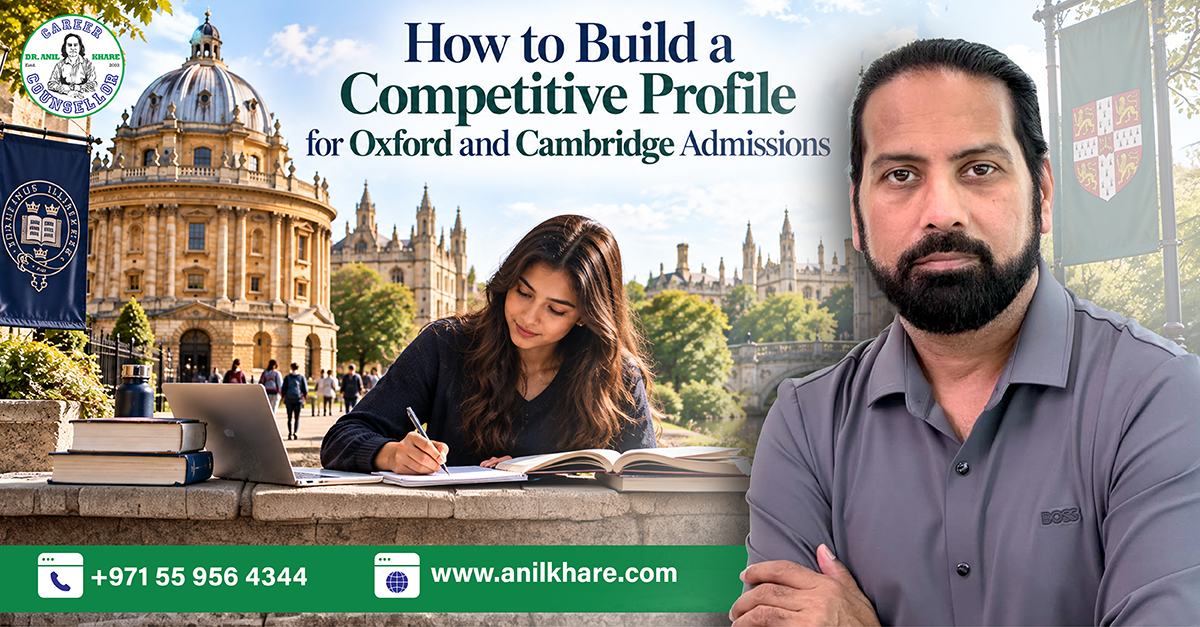
Oxford and Cambridge are among the world's oldest and most renowned universities, with centuries of academic tradition behind them. The University of Oxford traces its teaching back to at least 1096, making it the oldest university in the English-speaking world. The University of Cambridge was founded in 1209 by scholars who left Oxford, and it has since developed into another globally recognised centre of scholarship and research. Today, both universities attract high-achieving students from across the world, but gaining admission requires much more than impressive grades alone. The successful application will showcase academic ability, intellectual curiosity, subject commitment and the potential to excel in a challenging academic setting. So, how can students create a profile that really stands out?
What does it really take to build a competitive Oxford or Cambridge profile?
Applying to Oxford or Cambridge is not about collecting certificates, joining endless clubs or creating an impressive-looking resume. The real objective is to demonstrate academic ability, intellectual curiosity, subject commitment and the potential to thrive in a demanding university environment. Both universities assess applicants individually, with course-specific requirements playing a central role. Oxford considers academic records alongside elements such as admissions tests, written work, references, personal statements and interviews, depending on the course.
How important are academic grades?
Academic performance is the foundation of a strong Oxbridge application. Students are advised to thoroughly investigate the requirements for their chosen course and to work hard for good grades in relevant subjects. This is particularly important for IB, A Level and other international curricula as they require the choice of appropriate subjects as early as possible and sustained high standards of performance. Academic ability and potential are also key to Cambridge's admissions process.
Are extracurricular activities important for Oxford and Cambridge?
Yes—but perhaps not in the way many students assume. A long list of unrelated activities does not automatically strengthen an application. Oxford specifically explains that extracurricular activities are useful when they demonstrate the selection criteria relevant to the chosen course. The focus should therefore be on quality, relevance and reflection, rather than quantity.
What are super-curricular activities, and why do they matter?
Super-curricular learning means exploring an academic subject beyond the school syllabus. A prospective medicine student might read medical research, attend lectures or investigate a scientific question; a future law student could analyse legal debates or explore landmark cases. The key is not simply completing activities but thinking about what was learned. Oxford encourages students to use books, articles, podcasts, lectures, challenges and other resources to deepen subject understanding and develop critical thinking.
How can students demonstrate intellectual curiosity?
Ask better questions. Instead of simply reading around a subject, students should challenge ideas, compare perspectives, identify weaknesses in arguments and form their own conclusions. Cambridge looks for applicants who demonstrate critical and independent thinking, openness to new ideas and the motivation to explore beyond classroom learning.
What role do admissions tests and interviews play?
In some cases, the admissions test is a significant component of the selection process; students should find out the requirements for the course they are interested in well in advance. Oxford also refers to interviews as "academic conversations" which aim to "discover how applicants think, how they respond to unfamiliar ideas and how they engage with their chosen subject. Learning should therefore be based on the development of reasoning and discussion skills, rather than on memorisation.
When should students start building their profile?
In most cases, preparation should start well before the application year. Students will have a chance to build academic skills over time, to delve deeper into topics of personal interest, and to plan for the actual tests. Beginning earlier will afford students an opportunity to develop a true academic story and not just something that they create just before applying.
Where can UAE students get support with Oxford and Cambridge admissions?
Building a competitive Oxford or Cambridge profile requires planning, academic mentoring and a clear understanding of course-specific expectation. Students and parents in the UAE can reach out to AnilKhare.com, where Dr. Anil Khare provides academic and university guidance alongside the wider Amourion network. Support is available through Amourion branches across the UAE, including locations in Sheikh Zayed Road, Jumeirah Lakes Towers, Dubai Silicon Oasis and Abu Dhabi, with services designed around international curricula, university preparation and admissions guidance.
A strong Oxbridge application is ultimately more than a collection of achievements. It is a convincing demonstration of what a student knows, how they think, what genuinely interests them and how prepared they are to explore their chosen subject at a deeper level.
Contact Us
Phone: +971 55 956 4344 | +971 56 917 3311
Website: www.anilkhare.com
Email: anilkhare@anilkhare.com
WhatsApp:Click here to text us
Dubai Centers: Sheikh Zayed Road | Jumeirah Lakes Towers | Dubai Silicon Oasis Abu Dhabi: Hamdan Street
Curricula: IB | A Level | AS Level | IGCSE | American.
Modes: In Person | Hybrid | Online |
Our Centers: Sheikh Zayed Road, Dubai | Fortune Tower, Office 2401, JLT, Dubai | SIT Tower, Office 410, DSO, Dubai, Hamdan Street - Abu Dhabi